

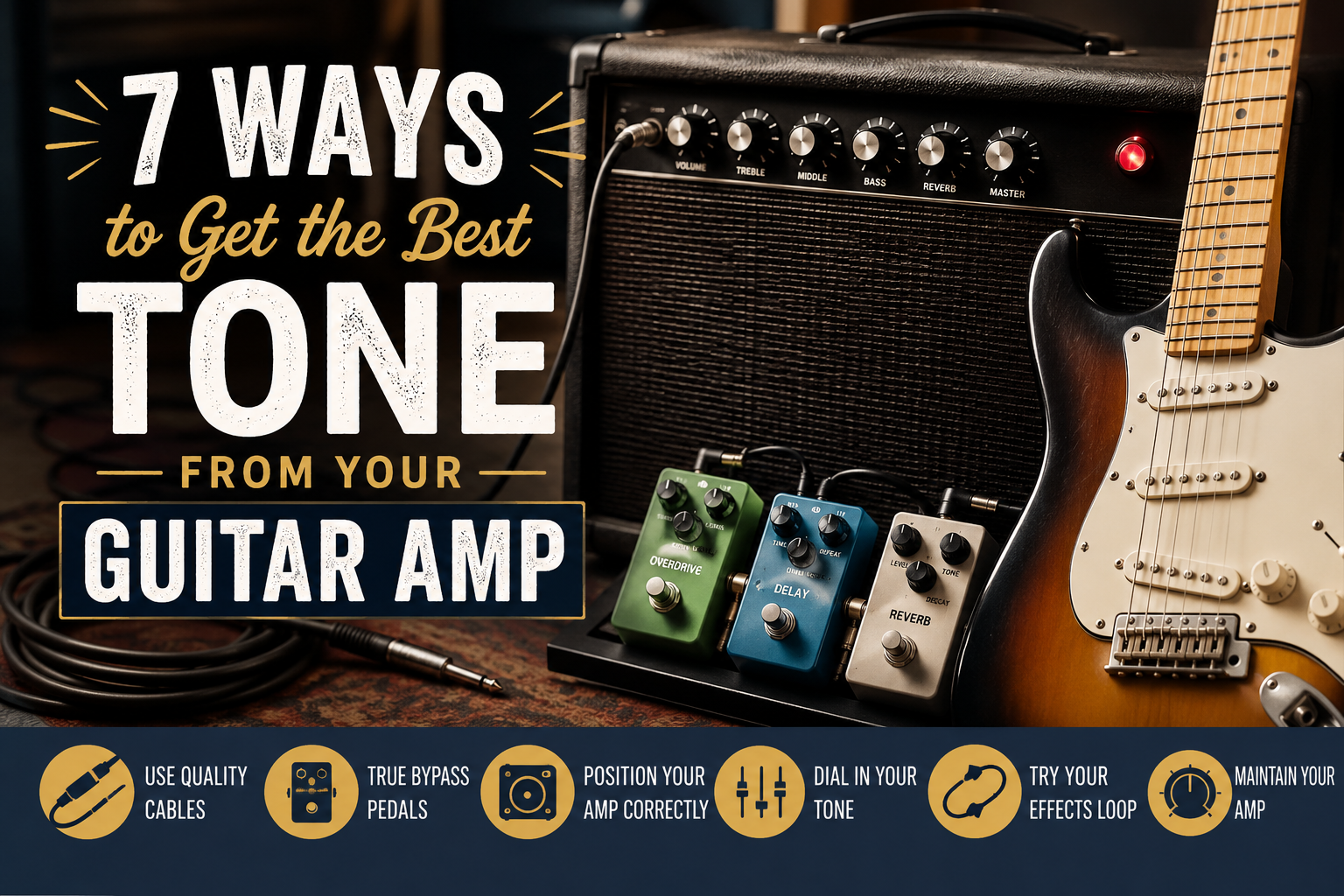
You don’t need expensive boutique gear to improve your guitar tone. Sometimes, getting the best sound from your rig comes down to a few simple amplifier maintenance habits and setup tweaks.
Legendary amp designer Leo Fender once said, “Until it’s recognized that the amplifier is at least 50% of the sound of the electric guitar, its full potential cannot be realized.”
Whether you play through a vintage tube amp, a modern modeling amp, or a compact practice combo, these seven tips can help your amplifier sound its best.
Tip 1 – Guitar Cables
While many players now use wireless guitar systems, a quality guitar cable remains one of the best ways to preserve your tone and reduce signal loss.
Cables from long-standing, reputable brands like Fender, DiMarzio, and Whirlwind, to name a few, should be fine. If you’re serious about cables, I recommend Mogami Audio Cables, as they’re true professional-grade. Also, it’s best to keep them 15’ and shorter, as long cables have more loss of high frequencies.
Tip 2 – True Bypass Pedals
If you use guitar effects pedals (ex. Ibanez Tube Screamer), it helps if its “on/off” switch is what’s known as True Bypass so your guitar’s signal is as pure as possible.
Briefly, with a True Bypass switch, when the effect is off, the input jack is hardwired to the output jack, so it does not load down or color your signal in any way. Check your pedal’s specifications to see if it has one, but know that most pedals are not true bypass but can usually be modified.
Another solution is to use a True Bypass Pedal (aka a true bypass looper), a pedal in its own right that you use with your existing pedals.
Larger pedalboards may also benefit from a quality buffer pedal or switcher to help maintain signal clarity.
Tip 3 – Keep Your Amp Tight and Rattle Free
Over time, your amplifier can vibrate itself loose, and then parts can start to rattle, so make sure all its screws, nuts, and bolts are snug. One important point is not to over-tighten the bolts holding the speaker to the cabinet, as it could bend the speaker frame and cause issues with the speaker. Just make sure they are tightly snug.
Tip 4 – Tone Controls
Turn your tone controls all the way up and turn down what you want less of (i.e., Treble, Mid, Bass).
For most amps, this gives your amp the most signal to work with. When you turn your tone controls all the way up, it’s common to turn the Treble down a little, as it can be a little too bright.
If you want more of a Fender-like sound, leave the Bass and Treble turned up and turn down the Mid. For more of a Marshall-like sound, turn the Mid all the way up and turn down the Bass and Treble. Adjust to your personal preference, but starting with the maximum signal is recommended.
Keep in mind that EQ controls react differently on tube amps, solid-state amps, and digital modeling amplifiers.
Tip 5 – Get Your Amp Off the Floor
There are various reasons for doing this, but the main one is to hear more clearly what’s coming out of it. When it’s on the floor, the sound is hitting your knees, and you’ll hear it differently than what the audience does. With it on the floor, the tendency is to boost the treble, resulting in an overly trebly-sounding amp for those out front.
Simple solutions include some amps coming equipped with tilt-back legs (e.g., Fender Twin Reverb), which allow you to tilt your amp back so it angles up at you, or putting it on a chair or a furniture dolly. You can also bolt casters to its bottom, which improves mobility. Also, there are commercially available amp stands that raise your amp off the floor and angle it, as well. With different options available, find the one that is right for you, but the important thing is to get it off the floor.
This can make a huge difference during live performances and rehearsals, where stage sound affects what both you and the audience hear.
Tip 6 – Keep Your Amp Controls Clean and Responsive
With the amp off, turn each control to its full range 7-10 times. Doing this helps keep your controls clear and free of debris. Build-up of dust or other tiny debris can cause your amp’s controls to not work properly and can reduce or disconnect your guitar’s signal.
I recommend doing this monthly or when you start to suspect your amp is acting squirrelly.
7. Effects Loop
Effects pedals are commonly placed before your amp, but if your amp has an Effects Loop, try them through the loop to see if you like the way it sounds. An Effects Loop is usually identified on an amplifier if it has input jacks labeled “Send” and “Return” or” Preamp Out” and “Power Amp In.” The great thing about an Effects Loop is that it allows you to plug in effects in between your amp’s preamp and power amp.
The general consensus is that delay and reverb pedals sound best when run through one of them. So try out all your pedals before the amp, then through the Effects Loop, and decide which you like best.
Time-based effects like delay, chorus, and reverb often sound cleaner and more spacious when used through an Effects Loop.
* * * * *
Great guitar tone starts with understanding how your amp responds to your playing style, pedals, and guitar setup. Small adjustments can make a huge difference, whether you’re practicing at home, recording in the studio, or playing live.
Doing these seven things with your amp will show it your love, and it will sing sweetly for you.
If you have any questions on these tips or any other amp issues, please feel free to contact me.
Keep on shining and being all of yourself.
~ Steve McKinley
If you want a refresher on the importance of your guitar strings and tweaking your guitar to its peak, see my earlier articles “Did You See That Girl’s String Bling?” and “I Now Pronounce You Player and Guitar.”
Editor’s Note: This article from August 17, 2013, was refreshed and updated in May 2026 with additional modern guitar amp and pedalboard tips.

