

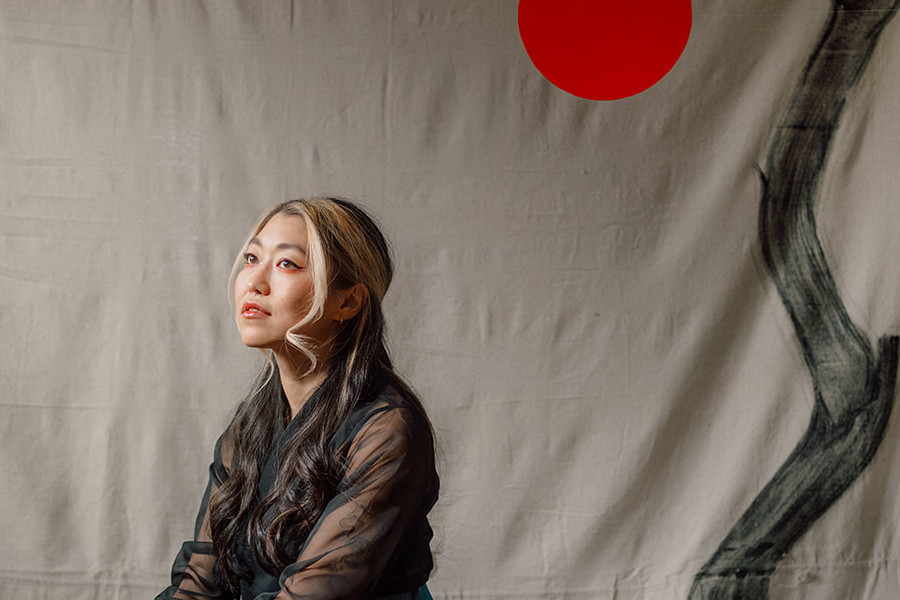
For more than a decade, Emilee Petersmark has helped shape the sound of The Crane Wives as a primary songwriter, co-lead singer, and guitarist.
Now, under the name Lee Emi, she steps forward with Destroy Everything, a solo debut forged through pandemic isolation, grief, illness, and a deeply personal exploration of identity as a Korean adoptee raised in Michigan.
Across the album, and on the stark, haunting single “Smoke in Empty Rooms,” Lee Emi turns the impulse to tear down what no longer serves her into an act of rebuilding, connection, and becoming.
In the conversation that follows, Lee Emi reflects on the experiences that shaped the record, the reclamation behind her new moniker, and the courage required to turn destruction into something entirely her own.
Destroy Everything is described as an album about tearing down the stories, assumptions, and identities that no longer serve you. When did you first realize this record needed to be about destruction as a path toward rebuilding?
I think the shift between ‘this album is about burning things down’ and ‘this album is about burning things down so new things can grow’ happened in the production process, long after many of the songs were written. A big chunk of this record was written between 2013 and 2016, but it wasn’t until 2020 that I was given the opportunity to sit down and actually record the record, building out the overall listening experience and trying to compile a cohesive message between songs that were written in my mid-20s and songs that were written in my mid-30s. Experience and time helped me to view many of these older songs through a new lens, one that understood that much of the anger and frustration in this record is really just grief and hurt. A big part of this album is leaning into all those ugly feelings that we normally want to push down, the feelings that we’re ashamed of, and holding them to the light to see where they came from. Beneath all of that rage and ugliness is usually something softer and lonelier and easier to connect to.
You’ve said the Lee Emi project is connected to reclaiming and reimagining your original name, Lee Sang-Eun. How did stepping into this name change the way you wrote, sang, or understood yourself on this album?
For years, Lee Sang-Eun felt like a costume. It never felt like something that belonged to me, even though it was the name from my original birth certificate. I wanted so badly to just be Emilee, to fit in with everyone else in my community growing up. The decision to rename myself for this project came after a trip back to the city where I was born (Suwon City in South Korea), and letting myself finally reckon with all of the parts of my past that have made me who I am today. I processed a lot of that experience through the writing on this record, as well as through building the visuals that accompany this release and this project as a whole. It’s terrifying to share such a vulnerable journey with an audience, but it’s also incredibly liberating and empowering.
“Smoke in Empty Rooms” comes from a deeply isolated moment during the COVID-19 lockdown, when grief and distance collided. What was the hardest part of turning that experience into a song?
I think the hardest part of writing a song about that period of time was allowing myself to create a song that didn’t feel as timeless as the others. Normally, when I write, I try to stay away from vocabulary that could date a song; for example, any references to specific technology would automatically give that song a window of time to exist in, and as a musician with folk roots, I really tried to avoid utilizing the sort of language and references that would force my listeners to picture a particular time in history. However, I felt like ‘Smoke In Empty Rooms’ needed that specificity. It was written about an experience that was wholly modern, even if the feelings attached to that experience (loneliness, isolation, and grief) were more timeless.
The single feels stripped down and fragile at first, then grows into something more layered and potent. How did you approach the arrangement so that it mirrored the emotional weight of the lyrics?
My producer, Ben Zito, and I really tried hard to keep from doing too much on this track. The simplicity of just finger-picked guitar and vocals creates a sense of loneliness that I wanted to lean into, and it was a practice in restraint to keep even the more layered moments small. One way we approached that was by limiting the instrumentation and letting light, airy vocal harmonies build the climax of the song in a way that emulated the bedroom demos I used to make as a young songwriter. The added vocals allow the song to grow without losing the intimacy of the acoustic, singer-songwriter beginning.

The album was written across a period that included pandemic isolation, a rare kidney disease diagnosis, and a lifelong search for belonging as a Korean adoptee raised in Michigan. How did those different threads begin to speak to one another in the writing process?
I feel like the pandemic era forced me to commit to putting in the work to get to a healthy place, whether it was through actually dealing with trauma, focusing on making my body healthy, or making sacrifices. I had too much time alone with myself. Too much time to think about all the things I wished were different about my life. I no longer had anywhere to run from myself. So, I did the only thing I could at the time: I faced the music. I asked my parents for my adoption paperwork. I went on a renal diet and committed to an exercise routine. I went back to therapy. And I kept writing. These journeys, maybe, started in different places, but they were all calling me back to the same place, one that forced me to confront the parts of myself that I was afraid of. I hate being grateful to the pandemic for anything, but I am grateful for that.
After years as a primary songwriter and co-lead singer/guitarist in The Crane Wives, what felt different about writing songs that were meant specifically for your first solo record?
I’ve been a songwriter for the Crane Wives for a long time, but part of the beauty of TCWs is that the foundational structure balances two (occasionally 3) primary songwriters. A lot of songs on this record are songs that didn’t fit what we were collaborating on as a team, and they got put on a backburner. It felt good to reclaim them for this project, leaning into what resonated with me the most when building the track list for this album.
You’ve described the impulse to break things when they feel unfair, unjust, or impossible to fix. How did you learn to turn that impulse into creative fuel rather than something purely destructive?
Therapy. Lots and lots of therapy. And not just any therapy, either. I left my long-term counselor and instead found a therapist that specialized in adoption trauma, one that I knew would push me into uncomfortable places as I explored the complexity of identity and the lasting effects of familial separation. I needed that push to move from that stagnant, self-destructive place to one that let new things grow. Together, my therapist and I traced the roots of those destructive impulses back to the mother wound and worked to build new neural pathways around the grief instead of running away from it.
There’s a tension in the album between collapse and construction, grief and hope. How important was it for Destroy Everything to offer listeners not just catharsis, but some kind of foundation to stand on afterward?
The older I get, the more I realize how anger only gets you so far. So, you burned it all down– now what? Embracing the anger and the ugly feelings is just the first step on a long journey, one that doesn’t really end. Healing isn’t a place you get to; it’s an action you commit to every day. It was incredibly important to me to make sure the narrative of this record reflected that commitment, recognizing that this destruction is meant to serve a purpose.
The track list includes titles like “Black Hole,” “Spinning Plates,” “Clean Slate,” and “Don’t Wake Me Up.” Do you see the album as moving through a narrative arc, and if so, where does “Smoke in Empty Rooms” sit in that journey?
While I love a concept album, I didn’t really intend for this album to follow a narrative, but rather to show insight into a story that is in process. It’s not a linear journey, though I do hope that the album gives a sense of conflict and eventual resolution as you move through the track list. “Smoke in Empty Rooms” lives in that non-linear space, exposing a moment of weakness and doubt so intense the only real response is to disassociate.
What did making the surrealist video for “Smoke in Empty Rooms” allow you to express visually that the song could only suggest sonically?
It was really exciting to build a visual representation of what it felt like to be isolated during the pandemic, echoing the loneliness in the instrumentals. We utilized mannequins to emphasize the sense of isolation, the distance of real connection, and the boundary between what we feel when we look at someone we love in person versus how we feel when we look at them through a screen. I really wanted to dig into the mimicry of normalcy we performed during the pandemic, and how fake it all felt at the time.
You’ve said you are in remission and have done extensive mental, emotional, and physical maintenance over the past several years. How did that sense of survival and readiness shape the confidence behind releasing this album now?
There’s nothing like being in remission from a disease with no cure to make you feel like you’re capable of tackling anything. It took so much work and patience to get to this point. It kind of felt like a gate I had to pass through in order to gain the emotional regulation and mental focus I’d need for this album release.
As you prepare to bring Destroy Everything to audiences on tour, especially beginning with a hometown show in Grand Rapids, what kind of connection are you hoping these songs create in a live setting?
Performing is one of my favorite parts of being a musician. I love being able to share my songs with people who find the same catharsis in them that I do. Being able to start this tour in my hometown means everything to me, because this is my community. These are my people. I’m hoping that I can put on the kind of show that captures the thrill of live performance while also creating an underlying connection for the people who come to listen.
Upcoming Tour Dates and Tickets
Follow Lee Emi Instagram | Facebook | Spotify | Website

