

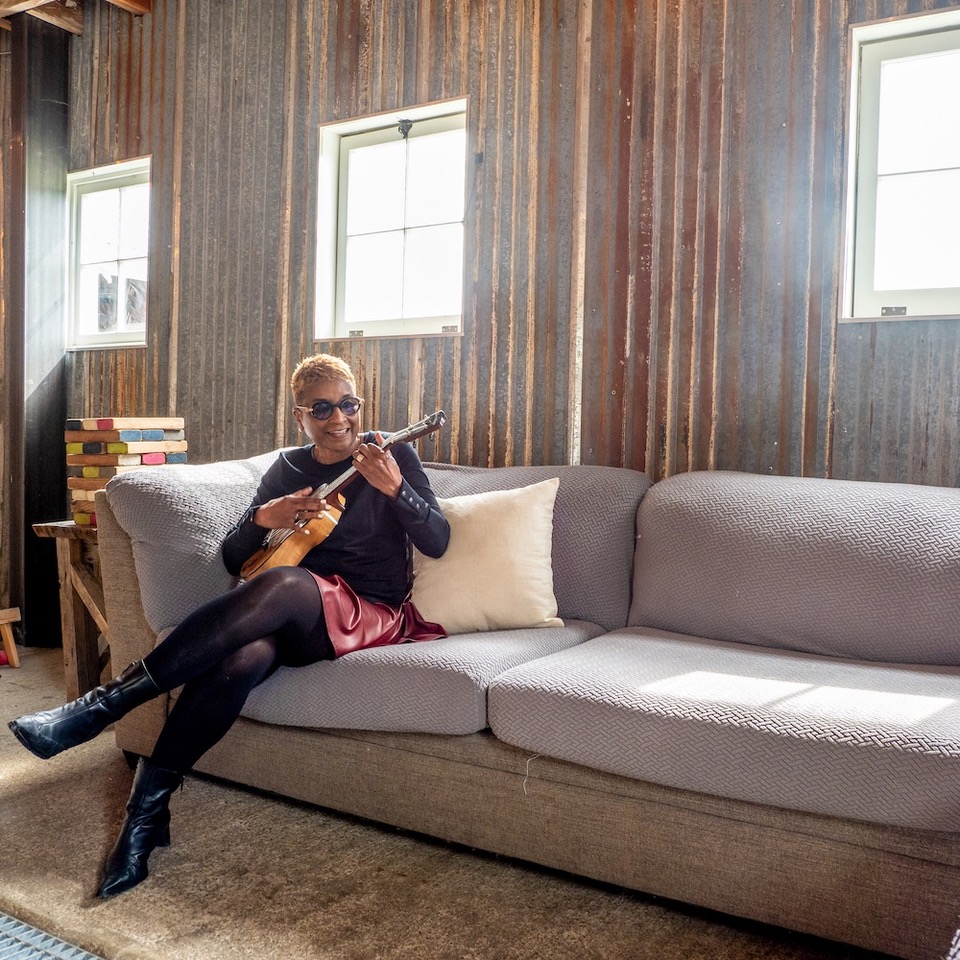
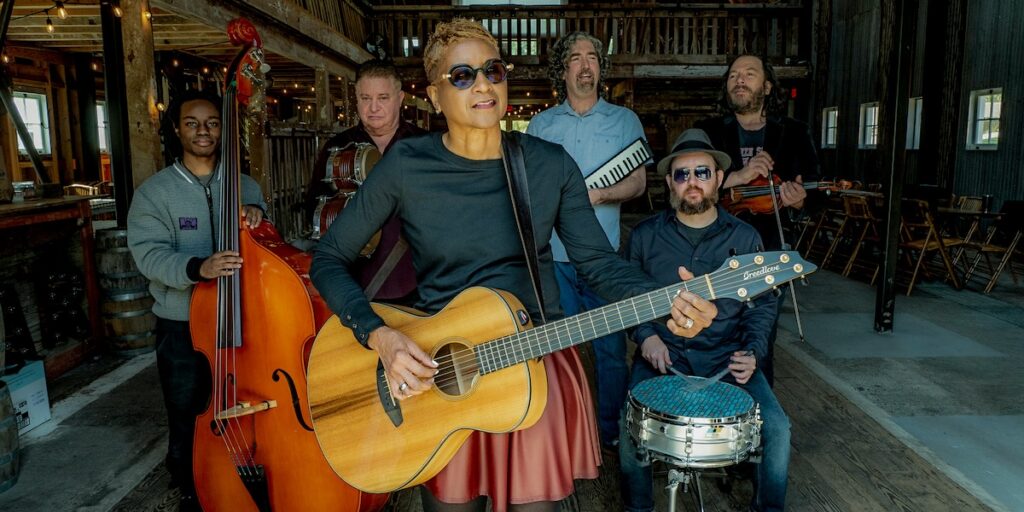
Known for blending folk, jazz, Americana, and roots music into what she calls “Soulgrass,” Paula Boggs has spent years crafting a sound that is as thoughtful and distinctive as the stories she tells through her music. Whether performing with her beloved Breedlove guitars, weaving rich three-part harmonies with her band, or creating songs rooted in authenticity and connection, Boggs approaches tone as something far deeper than gear alone — it’s an extension of identity, community, and artistry.
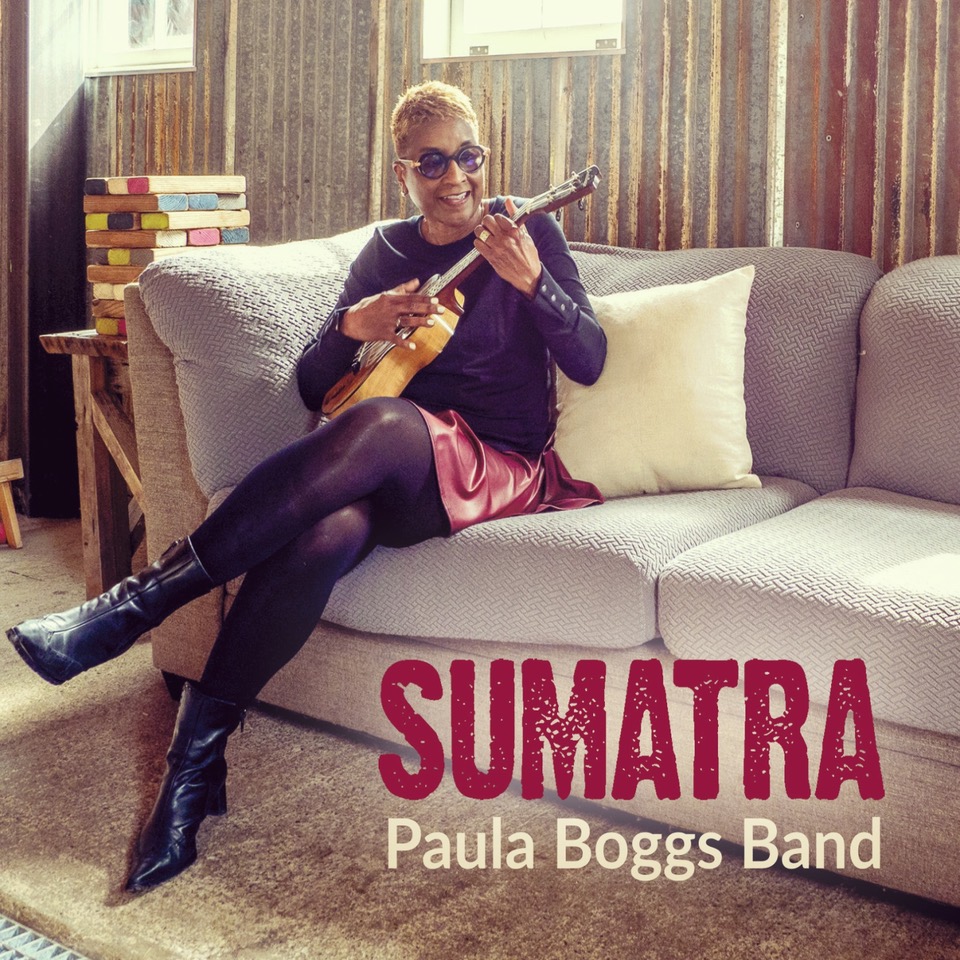
The band recently released their fifth album, titled Sumatra, via Independent/40:46, produced by Paula with Tucker Martine (Oregon), Matthew Brown (Seattle, WA), and Nicholas Denke (WA).
As she continues celebrating the release of new music and evolving the sound of Paula Boggs Band, Boggs joins in Tone Talk to discuss her go-to gear, songwriting process, studio philosophy, and the lessons she’s learned navigating the music industry as a woman artist.
What is your definition of tone, and how has it changed over the years?
For me, “tone” is the overall vibe visually and sonically from my instrument as an extension of me, the individual artist, and Paula Boggs Band. When the band launched in 2007, we were still forging an identity. Were we more jazz adjacent or folk? We had no three-part harmony. I was acoustic guitar agnostic and appeared on stage with different guitars. Around the time we released our second album, 2015’s Carnival of Miracles, we’d refined our artistic persona. We now called ourselves “Soulgrass,” we were in discussions with Breedlove Guitars and had ditched electronic bass in favor of a stand-up.
Nowadays I’m almost always on stage with a Breedlove Myrtlewood Guitar and Ukulele. Myrtlewood is native to the Pacific Northwest. It’s a rare hardwood known for its diverse colors — ranging from blonde to black, honey, and green — and fine grain. Myrtlewood is a perfect metaphor for us, a band that’s diverse in many ways. I use light-gauge strings and a thin pick to create sonic space for the music my bandmates and I weave together. The other major tools I use also hail from the Pacific Northwest — an Ear Trumpet Labs microphone and a Radial Engineering Preamp AC-Driver.
Which guitars, amps, and pedals are you currently using and why?
I’ve not used an amp in a show for years, preferring a Radial Engineering AC-Driver pedal/DI that plugs directly into a venue’s PA. AC-Driver is a studio-quality preamp built into a pedal format for acoustic instruments, designed to provide incredible sound and the ability to control levels while eliminating feedback on stage. Unlike a typical DI, you can connect the output of the AC-Driver directly to a powered speaker and control levels from on stage. It also lightens my load exponentially!
What about strings?
Elixir Light Acoustic Guitar Strings are renowned for their long-lasting tone. These strings are protected by Nanoweb or Polyweb coatings that prevent debris buildup between windings, resulting in a bright, consistent sound with reduced finger squeak. I highly recommend them.
Are there certain recording techniques you prefer in the studio?
I prefer a “live” sound where all of us are recording together in the same room or, alternatively, where we can see each other while in isolation booths to reduce the risk of sound bleed. We record vocals separately, but three-part harmony is recorded with everyone together in the same room, at the same time, and sometimes with a single microphone.
How do you keep your sound consistent onstage?
Practice, practice, practice, and lots of gigging!
What does your practice consist of?
For the past several years, we’ve rented band rehearsal space twice a month on Sunday nights at a Seattle artist collective called Equinox Studios. Beyond those, we have voice rehearsals either at my house or at the home of our keyboardist, Paul Moore. Because three-part harmony is central to our sound, we need to nail it every show. For me personally, I divide my time equally across songwriting, guitar practice, and voice. I have instrumental tracks of all songs that allow me to practice vocals focused only on my voice.
Favorite guitar riff or lick that inspired you to play guitar?
Mason Williams’ “Classical Gas” was released a year before I started guitar lessons, and Emerson, Lake & Palmer’s “From the Beginning” riveted me in my early years of guitar playing and songwriting. I can’t tell you how many times I’ve used those Major 7 chords.
What is your advice for young women who hope to work in the music industry?
The music industry is tough for any artist, but in my experience, it can be particularly hard for and on women. How you look is weighed more heavily. Youth in women is more prized and will fade. Navigating and avoiding sexual misconduct takes a lot of energy and is stress-producing. More. Young women need a team of people they trust and who are worthy of that trust — your village. People who tell you the truth even when it’s hard. People still around during the inevitable dark times. I read a Liza Minnelli interview recently where she talks about her mom, Judy Garland. Too many folks around Judy Garland didn’t do enough to help her in the dark times. You also need to find your audience. I’ve learned through trial and error that not every venue is “right” for us — not the right size, payment scheme, city or vibe. When you find your village and sandbox — and neither is “one and done,” it’s a journey, you may even need to do a 180 — but that’s when magic happens.
Sumatra tracklist:
- Sumatra
- Bard of Vietnam
- Route 66
- Still Grateful
- Note to Quinn
- Traces of You
- Wasting Young Man
- Airline Boogie
- The Snow It Melts The Soonest
- Ain’t Gonna Let Nobody Turn Me Round (feat. Valerie June & the Blind Boys of Alabama)
Musicians: David Salonen (upright bass/fiddle/acoustic guitar/bgv), Tor Dietrichson (percussion/vocal), Paul Matthew Moore (keys/accordion/percussion/bgv), Jacob Evans (drums/percussion), Darren Loucas (multi-instrumentalist) with Daniel Walker (Wurlitzer piano/Synth/Mellotron/Rhodes piano/accordion/piano), James Falzone (penny whistle/clarinet), Josh Neumann (cello), Arietta Ward (bgv), Valerie June & the Blind Boys of Alabama (vocals) & Members of the Evensong Choir of Saint Mark’s Cathedral.

